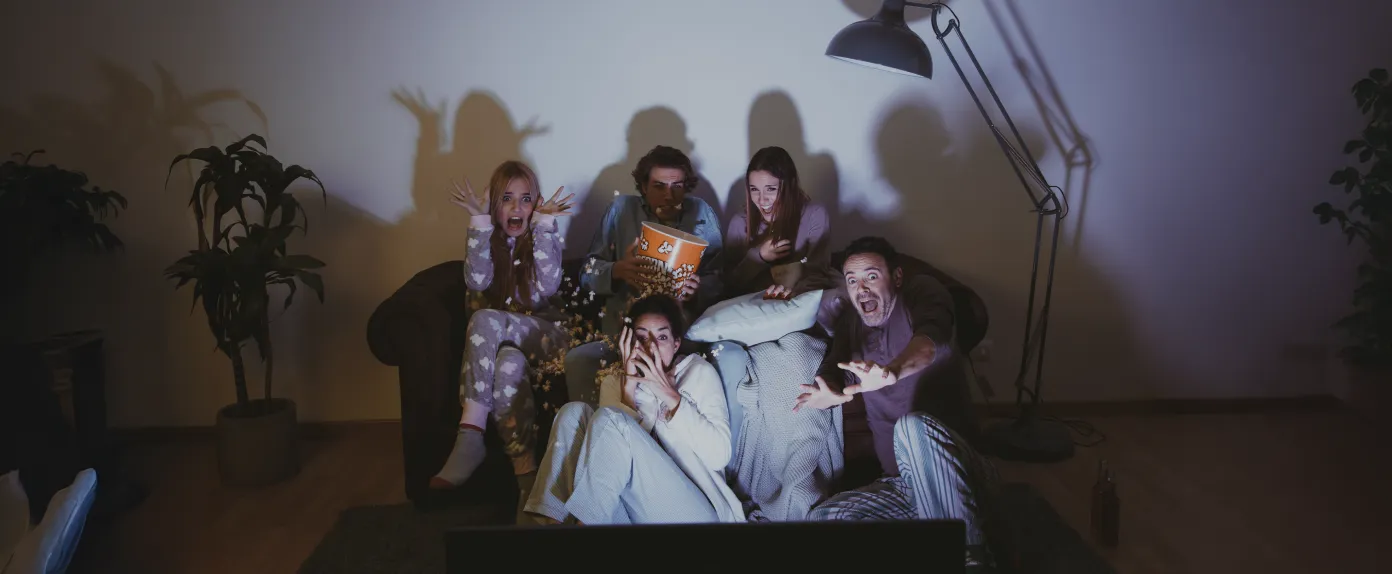
Horror is the only genre where audiences actively seek out the sensation of dread, and then argue about whether the film delivered it properly. Box office data backs this up: horror consistently outperforms its production budgets at a rate few other genres can match: horror pulled in 70% more box-office dollars in 2023 than in 2013. Gen Z, the current growing purchasing power dominant, loves it: according to Ampere Analysis, horror has consistently grown its share of favourite-genre audiences on streaming platforms by rising from 9.7% of US consumers in 2020 to 11.6% in 2024 among 18–24-year-olds.
And yet, for a genre with such reliable commercial pull, its internal architecture remains genuinely misunderstood. Most casual viewers treat horror as a single category, something to either stomach or avoid. The reality is considerably more layered. Horror subgenres don’t just separate films by surface aesthetics but reflect fundamentally different theories of fear, different cultural preoccupations, and different relationships between audience and screen.
What Are Horror Subgenres?
A subgenre is less a label than a lens. It describes the dominant mechanism through which a film generates fear, and the cultural or narrative logic that underpins it. The important caveat is that horror subgenres are unusually porous. A film rooted in supernatural dread might also be formally experimental; a slasher might carry the DNA of Gothic horror; a found footage picture might shade into psychological unease.
The categories overlap, borrow from each other, and occasionally collapse entirely. What matters is what each subgenre prioritises — because that shapes not just how a film feels.
Psychological Horror
Psychological horror has its clearest roots in the German Expressionist cinema of the 1920s — films preoccupied with distorted environments, fractured perception, and the unreliable interior. That tradition fed directly into mid-century American noir and later into the paranoid thrillers of the 1960s and 70s, when filmmakers on both sides of the Atlantic began using ambiguity and unreliable narration as primary formal tools.
The subgenre operates on the premise that the most frightening thing is what might be wrong inside a character’s own mind, and by extension, inside the viewer’s. The violence, when it comes, is often less important than the architecture of paranoia preceding it. Unlike a monster that can be killed or a ghost that can be banished, a mind in crisis offers no clean defeat.
Supernatural and Paranormal Horror
Supernatural horror roots predate cinema by millennia, running through oral tradition, religious mythology, and literary Gothic. Demonic possession narratives draw on Catholic iconography in Western cinema: exorcism rites, crucifixes, and Latin incantation. When the film industry codified it as a genre in the early twentieth century, it drew heavily from Victorian ghost literature and stage melodrama. European medieval folklore produced the revenant and the vampire centuries before Bram Stoker or Sheridan Le Fanu gave them literary form.
What has kept it commercially dominant is the genre’s relationship with belief. These films work because they traffic in systems of meaning that audiences recognise even when they don’t personally share them.
But comparable traditions exist across South Asian, East Asian, and Latin American horror, each with its own mythology and visual grammar. Japanese J-horror, for instance, developed a distinct supernatural language in the 1990s. It featured long-haired female spirits, cursed media objects, and vengeful hauntings that had a measurable influence on Western horror production in the early 2000s.
Slasher Horror
The slasher arrived as a recognisable form in the late 1970s, influenced by Italian giallo thrillers and earlier British horror, and dominated the American box office for most of the following decade. Its conventions — . Ssuch as an isolated setting, a masked or disfigured killer, a group of victims picked off sequentially, were quickly standardised. Do not forget the final girl trope—the lone female survivor whose relative moral sobriety is coded as the reason she lives.
Film scholar Carol J. Clover’s 1992 Men, Women, and Chain Saws remains one of the most cited pieces of genre criticism precisely because it showed how much ideological work those conventions were quietly doing. The slasher declined commercially in the late 1980s as audience fatigue set in and oversaturation had made the formula predictable, then came back in the mid-1990s through films that treated the slasher’s own conventions as part of the joke.
Contemporary entries are far more self-conscious about the formula than their predecessors. The final girl is no longer a passive victim who survives by accident. She tends to be active, knowing, and frequently aware of the very genre conventions she’s trapped in.
Monster and Creature Feature Horror
Creature feature horror has a direct line to the anxieties of its production era in a way that few other subgenres can match. The giant monster films that emerged from Japan in the 1950s (Godzilla being the most studied example) were made within a decade of Hiroshima and Nagasaki, and their preoccupation with radiation, scale, and unstoppable destruction was not incidental.
American creature features of the same period similarly processed nuclear paranoia through radioactive mutations and alien invasion narratives. Later decades brought ecological dread, pandemic fears, and anxiety about genetic experimentation. The monster, in other words, is almost never just a monster, but an externalization of a specific cultural fear into a physical form.
Zombie Horror
Surprisingly, zombie horror has always been political. The figure of the zombie originates in Haitian Vodou tradition and the history of colonial slavery. What’s behind the supernatural is a body stripped of will, forced to labour without rest or autonomy.
When the subgenre entered mainstream cinema in the mid-twentieth century, it carried that subversive weight forward, using the walking dead as a mirror for consumerism, conformity, and the fragility of social order. The genre’s global expansion since the 1990s is itself analytically interesting: South Korean zombie cinema has engaged with themes of class division and state failure. European entries and those from the US have leaned into pandemic allegory. Latin American productions have reworked the zombie through local political memory.
Found Footage Horror
Shaky cam, night vision, diegetic sound design. Found footage horror makes a specific formal bet: that the camera’s presence can generate fear rather than simply record it. The technique has older roots of low-budget mockumentary horror that was being made in the 1970s and 80s. A pair of films in the late 1990s and early 2000s turned the concept into a commercially dominant movement.
The subgenre peaked commercially through the mid-2000s before audience familiarity with its conventions eroded the central illusion. What remains is a formal vocabulary that continues to appear in hybrid works, often combined with psychological or supernatural elements to keep the unease alive.
Body Horror
Body horror is about the physical self as a site of violation, transformation, or decay — and it’s uncomfortable in a hard way to reason your way out of. The subgenre traces back to Victorian anxieties about medicine and Mary Shelley’s Frankenstein, but found its cinematic identity in the late 1970s and 80s, largely through David Cronenberg, whose films treated flesh, technology, and desire as one tangled system. Its staying power comes from how directly it maps onto real social fears about medicine, gender, and who controls the body.
Films in the subgenre directed by or centred on women have tended to engage specifically with reproductive anxiety, producing some of its most pointed work. It’s also one of the few horror types that sit comfortably in both arthouse and mainstream genre production at the same time.
Folk Horror
Folk horror places its characters inside isolated rural communities where old belief systems, seasonal rituals, or collective superstition have been tended with special care. The threat is communal: the horror comes from realising the community itself is the danger.
The term came into wider use in the 2000s to describe a cluster of British films from the late 1960s and early 70s, commonly called the “folk horror triangle”, united by paganism, sacrifice, and a particular unease about the countryside. Its revival since the 2010s, across British, Scandinavian, and North American cinema, has been linked to anxiety about nationalism, belonging, and the pull of pre-modern certainties in politically unstable times. Its lasting power comes down to one specific choice: it takes old belief systems rather seriously. That seriousness is what makes the threat stick.
Gothic Horror
Gothic horror predates cinema by over a century. Its conventions were set in late eighteenth-century literature — Horace Walpole’s crumbling castles, Mary Shelley’s creature, the psychosexual dread running through Sheridan Le Fanu. Universal Studios built an entire commercial identity around it in the 1930s, producing films whose visual language of shadow, stone, decay, and aristocratic menace still defines the subgenre today.
What has kept the Gothic alive beyond its commercial origins is its flexibility. It has always used monsters and outsiders as stand-ins for whatever a given society simultaneously fears and desires. The vampire is the clearest example: a figure of aristocratic seduction and bodily invasion that nineteenth-century literature used to channel anxieties about sexuality, class, and foreign contamination. That same ambiguity is why the Gothic has been especially influential on queer cinema. Monstrosity in this tradition has never been simply evil. It has been desirable, sympathetic, and misunderstood, which makes it a natural vehicle for stories about identity and belonging that mainstream genres struggle to tell straight.
Elevated and Arthouse Horror
The term “elevated horror” became common in critical discourse around the mid-2010s, largely driven by a cluster of films that received unusual festival attention — Sundance, Cannes, TIFF — for genre work that would previously have been distributed without awards consideration.
A24’s commercial success with several of these films turned what had been a critical observation into a marketing category, and the backlash followed quickly. Many filmmakers and critics reject the label because it implies horror outside the arthouse tradition lacks seriousness or craft, which is both historically inaccurate and condescending to genre audiences. What the label does usefully describe, even if imperfectly, is horror characterised by slow pacing, minimal scoring, thematic ambiguity, and a willingness to leave questions unanswered. Comparable work has been produced in Romania, South Korea, Mexico, and across West Africa for years.
Comedy Horror
Comedy horror is riskier than it looks.
The two genres operate on incompatible emotional frequencies. Comedy releases tension while horror depends on its accumulation, and films that attempt both usually succeed at one at the expense of the other. The rare films that manage both simultaneously tend to do so by leaning into horror conventions so completely that the comedy becomes a form of appreciation rather than deflation.
Sci-Fi Horror
Sci-fi horror locates the threat in technology, space, extraterrestrial contact, or the consequences of scientific ambition. It overlaps heavily with creature feature horror and body horror, but its emotional register is distinct: where monster movies often end with the threat destroyed and order restored, sci-fi horror tends to leave the audience with a sense that the danger isn’t over.
Emerging and Niche Subgenres to Know
Several subgenres have developed or consolidated their identities recently.
- Aforementioned Giallo films, defined by stylised violence, primary colour lighting, and mystery plotting, have seen renewed critical interest and direct influence on contemporary horror aesthetics.
- Survival horror, which strips the narrative down to a single character’s endurance against extreme conditions, has grown into a recognisable form.
- Haunted house films, technically a setting rather than a subgenre, have developed enough conventions to function as one.
Which Type of Horror Is Right for You?
Horror, as a genre, has always been made everywhere. The subgenres map onto different psychological responses — fear of the unknown, fear of the body, fear of the community, fear of one’s own mind — and those responses are not uniform.
The psychology behind different film genres offers useful context for why this mode of filmmaking produces such a distinct viewer response. You can find out what your favorite movie genre says about you.
For audiences looking to meet various horror conventions, including international horror with its own distinct regional conventions, platforms like UVOtv offer access to global cinema that rarely gets visibility in mainstream distribution. For anyone trying to figure out what kind of horror to watch, start with the horror movies library on UVOtv.
FAQ
What is the most popular type of horror movie?
Supernatural horror and slasher films have historically been the highest-grossing subgenres at the global box office, though psychological horror has gained significant commercial ground since the mid-2010s.
What’s the difference between supernatural and paranormal horror?
The terms are often used interchangeably, but supernatural horror is the broader category. It includes any force operating outside natural law. Paranormal horror typically refers more specifically to ghost, haunt, and spirit-based narratives, often with an investigative or documentary framing.
What is elevated horror?
Elevated horror is an informal label for horror films that prioritise atmosphere, thematic complexity, and arthouse aesthetics over conventional genre mechanics. The term is contested; many critics argue it implies that standard genre horror lacks artistic merit, which is historically inaccurate.
Can a horror movie belong to multiple subgenres?
Yes — and most notable horror films do, since subgenres describe tendencies and emphases. A ghost story set in a crumbling ancestral home might be simultaneously supernatural, Gothic, and psychological.